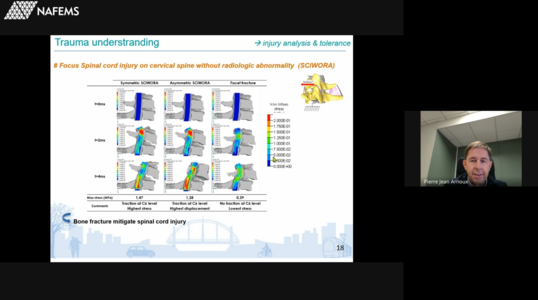
Over the past fifteen years, computational human body modeling has undergone remarkable advances, driven by the continuous development of finite element methods, multiscale and multicore computing, and, more recently, the integration of data science and artificial intelligence approaches. These advances have expanded the scope and impact of numerical simulation in biomechanics considerably, enabling increasingly realistic and predictive representations of the mechanical and physiological response of the human body.
Today, computational human body models support a wide range of applications, from the design and assessment of safety systems to the investigation of injury mechanisms, the optimization of protective devices, and the reconstruction of traumatic events for forensic purposes. They are also becoming essential tools in clinical practice, contributing to the development of medical devices, patient-specific treatment planning, and surgical decision support.
Such progress relies on three fundamental pillars:
- The development of anatomically and biomechanically relevant computational models
- Access to high-quality experimental data for calibration and validation
- The execution of large-scale simulation campaigns to explore complex loading conditions and clinical scenarios
Through several illustrative examples, this webinar will:
- Highlight the key scientific and technological challenges associated with computational human body modeling, including model development, verification and validation, and application-driven simulation strategies.
- Demonstrate how these approaches contribute to advancing our understanding of trauma, improving injury prevention, and supporting the emergence of personalized and predictive medicine.
Our Speaker
Pierre Jean ARNOUX
Laboratoire de Biomécanique Appliquée
Laboratoire International Associé iLab-Spine en imagerie et biomécanique du rachis
Pierre-Jean Arnoux is a senior researcher in biomechanics and human body modeling at the Applied Biomechanics Laboratory (LBA), and Vice-President for Innovation, Valorization and Partnerships, both at Université Gustave Eiffel – Aix-Marseille Université, which he has directed since 2018 (now ~80 people). Trained in applied mathematics and solid mechanics, with an HDR in medicine from Aix-Marseille University, he has spent over two decades pushing "virtual human" models toward real-world impact — from predicting spinal cord injury after trauma to designing airbags for motorcyclists and protective gear for skiers.
He also directs iLab-Spine, a France–Canada international lab dedicated to spine imaging and biomechanics, and currently serves as President of the International Society for Snowsport Safety. His work bridges fundamental biomechanics, clinical application, and industrial partnership and includes over 140 peer-reviewed articles, 4 patents, and the supervision of more than 40 PhD students.