This Website is not fully compatible with Internet Explorer.
For a more complete and secure browsing experience please consider using Microsoft Edge, Firefox, or Chrome
High speed testing of metallic alloys for high speed metal forming process simulation
The presentation provided an introduction to high speed testing including the basic concepts, reasons and theory before detailing the Hopkinson bar and Drop Hammer tests that are carried out at Mondragon University (Spain).
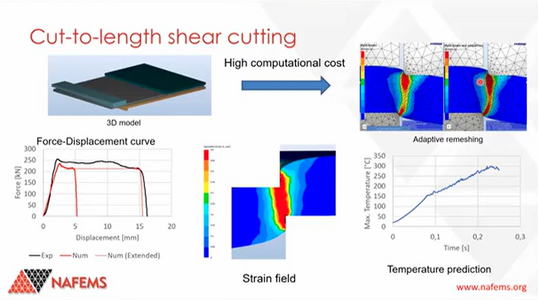
To clearly demonstrate the usefulness and application of these test results, some current industrial cases were also described: simulation of cold forging processes, simulation of shear cutting processes and the simulation of impact hot forging processes.
conclusions and future outlook were provided.
In numerical simulation of manufacturing processes and crashworthiness, accurately capturing the dynamic behavior of metallic alloys at intermediate and high strain rates is critical. Under these rapid loading regimes, materials exhibit complex rate-dependent phenomena that deviate significantly from quasi-static behavior—spanning positive and negative strain rate sensitivity (dynamic strain aging), adiabatic heating, shifts in ductile and brittle fracture limits, and microstructural transformations such as dynamic recrystallization.
Today, high-speed material characterization and constitutive modeling support a wide range of engineering applications, from high-speed metal forming, hot forging, and industrial cut-to-length (shearing) operations to crashworthiness and impact safety assessment. However, obtaining reliable experimental data at these velocities is challenging: conventional universal testing machines suffer from wave propagation effects, loss of force equilibrium, and mechanical resonance ("system ringing") that superimpose spurious oscillations onto the true material response.
Overcoming these challenges relies on three fundamental pillars:
Understanding the physical mechanisms governing rate-dependent plasticity, adiabatic heating, fracture, and microstructural evolution across strain rates
Resolving dynamic experimental limitations—specifically force equilibrium conditions and system ringing—by transitioning from conventional testing machines to stress-wave-based Split-Hopkinson Pressure Bar (SHPB) systems and drop/impact facilities
Integrating high-speed experimental data into predictive finite element process simulations to accurately model industrial forming and cutting operations
Through a combination of theoretical fundamentals and industrial case studies, this webinar will:
Detail the key scientific and experimental challenges in dynamic material testing, including wave propagation mechanics, force equilibrium criteria, and the operation of classical and advanced Hopkinson Bar systems.
Showcase the high-speed testing capabilities at Mondragon Unibertsitatea and demonstrate how dynamic material characterization is applied to real-world process simulations in forging and cut-to-length manufacturing.
Our Speakers
Dr. Lander Galdos
Dr. Lander GALDOS is senior researcher of the Department of Mechanical and Industrial Production at Mondragon Unibertsitatea (MU), where he develops research activities related to metal forming and forging and lectures several manufacturing related subjects. He has led several national and European projects focused on creating innovative manufacturing processes.
Dr. Borja Erice
Dr. Erice is Ramon y Cajal and Ikerbasque Research Fellow in the Department of Mechanics and Industrial Production at Mondragon Unibertsitatea (MU), where he develops research activities related to the experimental, theoretical and computational mechanics of materials and structural components subjected to extreme loading conditions such as impact. He also lectures on several solid mechanics related subjects.
Dr. Julen Agirre
Dr. Julen Agirre is full member of the Advanced Material Forming Processes research group of Mondragon Unibertsitatea, where he develops different research and lecturing activities. He is expert in hot forging simulation and microstructural evolution modelling considering extreme strain rate conditions such as hammer forging.
David Abedul
David Abedul is PhD student in the Department of Mechanical and Industrial Production at Mondragon Unibertsitatea (MU). His research work is mainly focused on the characterization of shearing processes applied to thick metal plates (thickness ≥ 5mm) where high velocity testing is of major importance for good process modelling.