The NAFEMS World Congress 2027 in Vancouver, Canada, will bring the global engineering simulation community together again from 25-28 April.
Traditional simulation methods are the bedrock of our industry. Today, many of those processes are evolving into intelligent engineering workflows. We are not, however, pursuing a world where AI/ML replaces that solid base of engineering expertise. What we are aiming for is an engineering simulation world where validation and human expertise underpin these new developments, producing even more trustworthy simulation results on which to base better decisions.
The community wants to hear your story, your experience, and your message. We want to know how you are navigating new technological advances and certification hurdles, and to hear about the practical applications of your work.
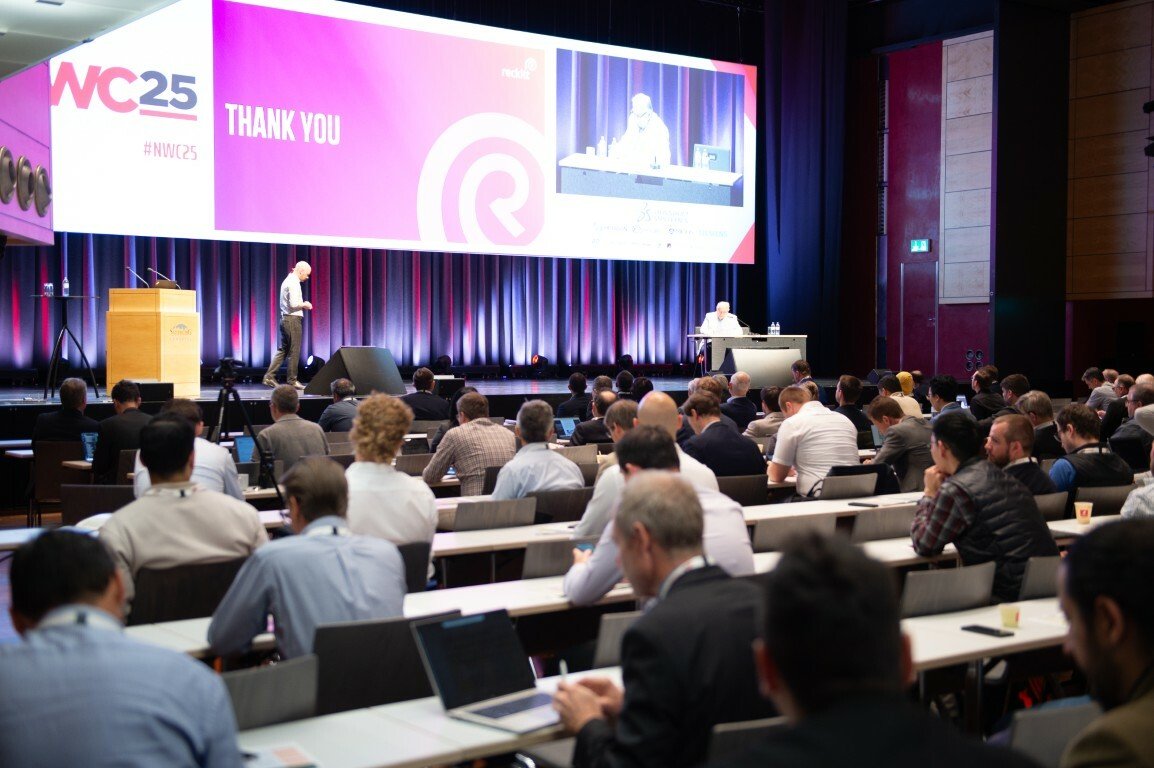 | “Presenting at NWC is a dream come true!” Andrea Corazza, Senior CAE Analyst, SPM Engineering s.r.l. |
From industrial users and software vendors to industry experts, academic researchers and technology innovators, the NAFEMS World Congress brings everyone together.
You bring your work and we will bring you an audience of your future collaborators, your challengers, and your inspiration.
21st NAFEMS World Congress | 2,900+ abstracts submitted since 2013 | 2 in 3 delegates come to listen, not present | 15% off registration for presenters |
The simulation community’s flagship event, since 1987.
“I'm always interested in presenting at NWC - I always come away from each Congress with new and useful ideas.” Louise Wright, National Physical Laboratory |
● | ● | ● | ● | ● |
9 Nov 2026 | Mid-Dec 2026 | 31 Jan 2027 | 1 Mar 2027 | 2 Apr 2027 |
Abstract deadline | Acceptance decisions | Extended abstract or full paper due | Presenter registration deadline | Presentation submission deadline |
What presenting gets youAn audience that came to hear you. Most of the room is there to learn rather than present. Your session is the reason they are in the room. A permanent record of your work. Your presentation summary is published in the Congress proceedings, and you have the option of submitting a full paper for review and publication in EMAS, The NAFEMS Journal. Recognition. The strongest contributions are considered for the NWC Best Paper Awards. A reduced registration rate. Presenters register at US$1,998 for the full four-day Congress, 15% below the standard member rate. See registration details. |
The Congress hosts sessions and presentations covering every conceivable aspect of engineering modelling, analysis, and simulation, from every industry. If you've found your way to the NAFEMS website, chances are your topic is relevant.
If you're unsure, take a look at the list on the right. If you're still unsure, email us at nwc@nafems.org and we'll be happy to advise.
“an excellent opportunity to interact with international experts, gain exposure to the latest developments in engineering simulation, and establish valuable research collaborations.” Anoop Gopinathan, Sree Chitra Tirunal Institute for Medical Sciences and Technology (SCTIMST) |
Important - please read the NAFEMS Author & Presenter Guidelines which apply to NWC27, and all NAFEMS events.
Whilst we prioritise original submissions, we are open to adapted content. If you plan to reuse or build upon material presented at a previous event, please email nwc-reviews@nafems.org for approval prior to submitting your abstract.
Artificial Intelligence (AI), Machine Learning (ML), AI-Driven Simulation, Agentic AI, Large Language Models (LLM), AI Preprocessing, AI Visualisation, Infrastructure for AI, Engineering Data Science (EDS), Surrogate Modelling, Reduced Order Modelling
Dynamics & Vibration, Linear Dynamic, Modal Analysis, Rotating Dynamics, Multibody Dynamics (MBD), Damping, Seismic, Acoustics, Aero Acoustics, Vibroacoustics, Noise Vibration and Harshness (NVH)
Computational Structural Mechanics (CSM), Structural, Nonlinear Analysis, Fatigue, Fatigue Crack Growth, FKM, Fracture, Cracking, Damage, Failure, Buckling, Collapse, Limit Load, Shakedown, Ratcheting, Creep, Contact, Impact Shock & Crash, Shock, Explosion / Blast Analysis, Residual Stress, Thermal Stress, Stress Concentrations, Stress Linearization, Pressure Components, Bolted Connections, Bonded Joints, Spot Welds, Welding & Joining, Tribology, Wear
Optimisation, Topology Optimisation, Adjoint Optimisation, Multi-Disciplinary Optimisation (MDO), Multi-Objective Optimisation (MOO), Generative Design, Robust Design, Design Of Experiments (DOE), Response Surface, Surrogate Modelling, Sensitivity Analysis, Latin Hypercube, Monte Carlo, Probabilistic, Stochastics, Uncertainty Quantification (UQ), Process Integration and Design Optimisation (PIDO)
Material Characterisation, Material Failure, Composites, Composite Failure, Woven Composites, Delamination, Plasticity, Crystal Plasticity, Hyperelastic, Viscoelasticity, Yield Criteria, Yield Stress, Equations of State (EoS), Phase Transformation, Adhesives, Metal, Concrete, Rubber, Foam, Glass, Granular Material, Chemistry, ICME, Multiscale Analysis, Atomistic Scale Modelling, Molecular Scale Modelling, Multiphysics, Fluid Structural Interaction (FSI)
Simulation Data Management (SDM, SPDM), Simulation Governance, Simulation Management, Simulation Strategy, Analysis Management, Verification & Validation (V&V), Code Verification, Quality Assurance, Simulation Supporting Certification, Certification, Standards, ISO9001, ASME, AP209, Maturity, Integration of Analysis & Test, Testing, CAD Integration, CAE in the Design Process, Interoperability, Democratization, Designer-Oriented Simulation, Business Impact of Simulation, Education
Structural, Fluid Flow, Thermal, Acoustics, Computational Electromagnetics (CEM), Optical
High Performance Computing (HPC), Graphical Processing Unit (GPU), Cloud Computing, Parallel Processing, Solvers, Software, Hardware, Licensing, Preprocessing, Post Processing, Visualization, Scripting, Automation, Low Code, Augmented Reality (AR), Virtual Reality (VR)
1D System Analysis, System-Level Simulation, Systems Engineering, MBSE, Functional Mockup Interface (FMI), Code Coupling, Cosimulation, Discrete Event Simulation (DES), Digital Twins, Digital Engineering (DE), Internet of Things (IoT), Asset Management, Real Time Simulation
Computational Fluid Dynamics (CFD), Fluid Flow, Steady Flows, Unsteady Flows, Turbulence Modelling, Multiphase Flow, Free Surface Flows, Cavitation, Buoyancy, Mixing, Combustion, Atmospheric Flow, Ground Water Flow, Heat Transfer, Thermal, Conduction, Convection, Radiation, Aero Acoustics
Metals Manufacturing, Additive Manufacturing (AM), Design for Additive Manufacturing, Injection Moulding, Machining & Cutting, Welding & Joining, Heat Treatment, Composite Manufacture, Process Simulation, Residual Stress
Finite Element Analysis (FEA), Finite Volume Method (FVM), Boundary Element Method, XFEM, Isogeometric Analysis (IGA), Equilibrium Finite Element Analysis, Discrete Element Method (DEM), Smooth Particle Hydrodynamics (SPH), Particle Methods, Lattice Boltzmann Method, Peridynamics, Explicit Analysis, Multibody Dynamics (MBD), Real Time Simulation, Meshing, Adaptive Meshing, Batch Meshing, Moving Mesh, Geometry Morphing, Image Based Modelling, Submodelling, Substructuring, Model Reduction Techniques, Reduced Order Modelling, Error Estimation, Stabilization Techniques, Ray Tracing Methods
Aerospace, Automotive, Automated Driving, Electric Vehicles, Batteries, Defence, Energy, Nuclear, Oil & Gas, Process Industry, Marine, Rail, Civil Engineering, Geotechnical, Biomedical, Consumer Goods, Electronics, Industry 4.0, Sustainability
Not exhaustive. View the full topic listing or email nwc@nafems.org.

Stay up to date with our technology updates, events, special offers, news, publications and training
If you want to find out more about NAFEMS and how membership can benefit your organisation, please click below.
Joining NAFEMS© NAFEMS Ltd 2026
Developed By Duo Web Design