This Website is not fully compatible with Internet Explorer.
For a more complete and secure browsing experience please consider using Microsoft Edge, Firefox, or Chrome
NAFEMS Central-Eastern Europe Student Award Winner: Márk Csikszentmihályi
Meet the NAFEMS Central-Eastern Europe Student Award Winner:
Márk Csikszentmihályi, Budapest University of Technology and Economics
5-minute read
Márton Grόza - Nov 5th 2026
Márk Csikszentmihályi is the winner of the 2025–2026 NAFEMS Eastern Europe Student Award. He talked to us about his education, his simulation work, and the inspiration behind the project. He discusses his research into the aeroacoustics of human voice production, his move to Austria, and his recommendations for future students.
Tell us a bit about yourself.
I am a mechanical modelling engineer from Hungary, currently pursuing a PhD at Graz University of Technology, where I am also employed as a project assistant. I graduated from Budapest University of Technology and Economics with a Bachelor’s degree in Mechanical Engineering and a Master’s degree in Mechanical Engineering Modelling.
My main interests are fluid mechanics and acoustics, and the way these two fields are interconnected. During a two-year internship at SciEngineer, I gained practical experience in engineering simulations, learning its fundamentals and software usage. Towards the end of my Master’s studies, I moved to Austria, where I started working with open-source simulation tools. This motivated me to look beyond simply using the software and develop a deeper understanding of the numerical methods behind it.
How did you first get interested in engineering simulation?
During my early university years, I joined a competition team that designed and built solar-powered boats. Here, I saw how experienced team members used simulations to improve the boat’s hydrodynamic efficiency. Their enthusiasm and dedication really inspired me, and I tried to learn as much as I could from them. This was my first real insight into how numerical simulations could be used to solve practical engineering problems.
How would you explain the topic of your thesis to a non-expert in a few sentences?
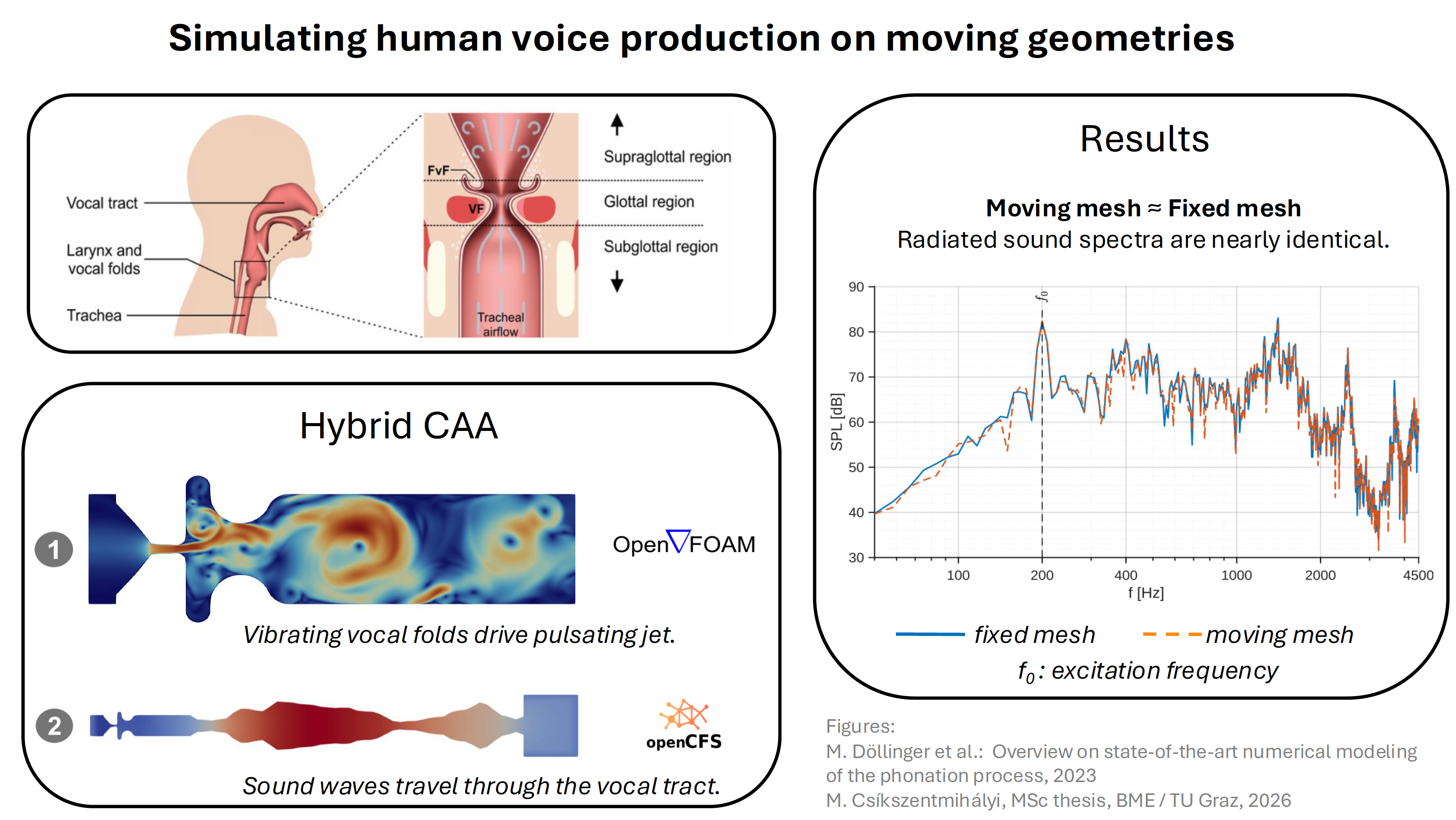
I approached a primarily biological phenomenon – human voice production – from an engineering perspective. When we speak, air flowing out of our lungs causes the vocal folds to vibrate, producing a highly unsteady, pulsating flow. These pressure fluctuations generate sound waves that later emerge from our mouths as speech. This phenomenon is part of the broader field of aeroacoustics, which studies flow induced sounds. In my thesis, I investigated this process using computer simulations and explored ways to improve existing methods.
Which simulation methods did you use in your thesis?
My thesis involved an approach known as hybrid Computational Aeroacoustics (CAA), which consists of two consecutive simulations. First, I simulated the airflow using OpenFOAM, an open-source tool that applies the Finite Volume Method. I then used the results to solve the corresponding acoustic wave equation with openCFS, another open-source software based on the Finite Element Method.
What was the most surprising or exciting result you found?
Perhaps that my initial hypothesis turned out to be wrong. I expected a moving acoustic mesh to produce different and more accurate results than conventional approaches. However, the simulations did not confirm my expectations. Although initially disappointing, I realised that disproving a hypothesis can be just as valuable as confirming it.
Did you collaborate with an industrial partner or research group? If yes, how did that influence your work?
I conducted my research at the Institute of Fundamentals and Theory in Electrical Engineering at TU Graz, under the supervision of Prof. Dr. Manfred Kaltenbacher. This gave me confidence and sense of responsibility, helping me grow both professionally and personally.
What motivated you to submit your thesis to the NAFEMS Central-Eastern Europe Student Award?
When you have put a lot of effort into something, it is natural to be curious about how others perceive it. I also felt responsible to make our research more widely known, especially across Central and Eastern Europe.
What advice would you give to students who are just starting to use simulation in their projects?
Don’t be discouraged just because others are more experienced than you. Everyone starts somewhere, and learning takes time. I often compare this to preparing for an exam. I used to get frustrated when I couldn’t understand the material at first, but every hour of studying brought me closer to understanding it when it mattered most – at the exam itself.
In an ideal scenario, what kind of engineering problems would you like to work on in 5–10 years?
I have developed a genuine passion for acoustics and would love to continue working in this field. As industries evolve, noise pollution is becoming an increasingly important issue, creating new demands on engineers. I hope to contribute to solving these challenges with the knowledge and experience I have gained so far. Ultimately, making a positive contribution to the world we live in is something I deeply care about.