This Website is not fully compatible with Internet Explorer.
For a more complete and secure browsing experience please consider using Microsoft Edge, Firefox, or Chrome
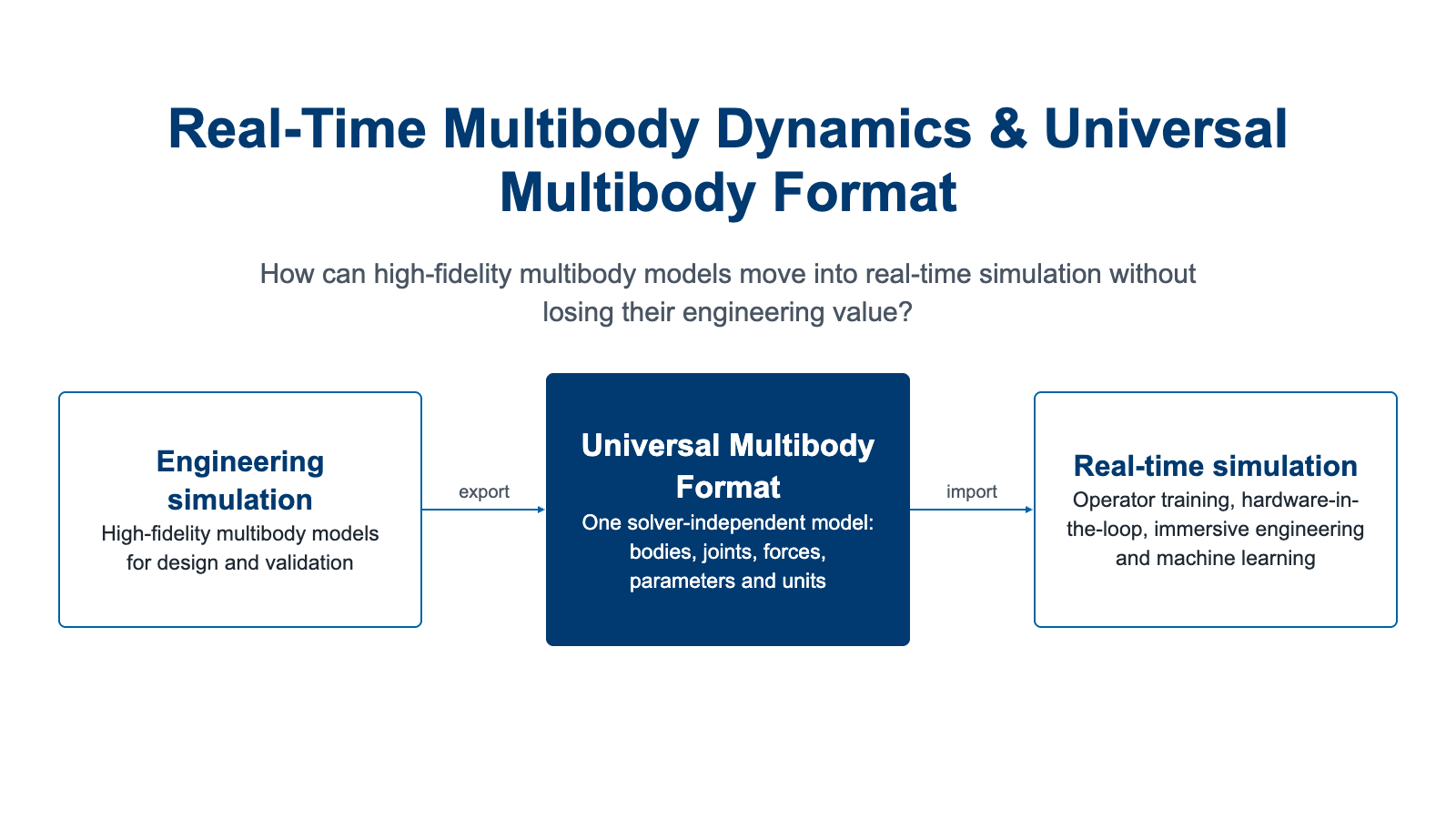
A fair real-time benchmark means running the same model on different solvers, which needs a way to transfer models without losing fidelity or parameterisation: hence the second strand, a Universal Multibody Format. Industry already uses several multibody codes on one product, and linking design analysis with real-time simulators, hardware-in-the-loop (HIL) testing and operator training depends on models moving cleanly between them.
Discussion
Engineering tools prioritise physical accuracy; robotics workflows trade some fidelity for speed.
A model exported from a CAE multibody code can be now ran in a real-time solver with stable contact and interactive control, showing clear potential for operator training.
Declarative descriptions are easier to validate than procedural scripts. Existing co-simulation standards suit system integration but fall short when coupling two multibody models directly.
Agreement
Define end-use requirements before choosing a format. Operator training and HIL testing both run in real time but need very different fidelity, which decides what a common file must contain.
Start with oneway link: CAE-grade multibody simulation to real-time simulation.
Develop a staged benchmark suite. From a pendulum and slider-crank, through closed-loop mechanisms, contact and a nonlinear deployable hinge, up to a full industrial model.
Future plans
The kickoff is the first of three sessions over the next six months, within a three-year project:
Meeting 2 – State of the art. A review of existing standards across multibody, real-time, AI/ML and model representation, so the team builds on current work.
Meeting 3 – Back to industry. Industrial users present their bottlenecks moving models between design, analysis, real-time and controls; vendors respond.